Living Georgia’s higher education reform
Shortly after the Georgian government unveiled its higher education reform in October 2025, I was in a coffee shop with a friend who has worked in the education field for decades. When I reached for my wallet, he stopped me. “Keti, let me pay. You can pay once your salary is 10,000.” Later that day, another friend called, a sharp economic analyst in a senior role in the private sector. “Girl, congratulations on the reform! Finally, you’ll have a decent salary.” The first friend was joking, with his usual sarcasm. The second was completely serious.
10,000 Lari, roughly €3,400 and four to five times the current average faculty salary in Georgia, was one of the reform’s loudest headlines. Somewhere between those two conversations, I understood how blinding a populist promise can be. If someone as my analyst friend believed it, much of the country probably did too that the reform would improve the higher education, moreover that many were won over another big reform headline – free education at public universities. More ironically, even, many professors, worn down by years of academic precarity, seemed ready to believe in the promise of a far higher salary.
Beneath the headlines lies a different story. This autoethnographic reflection on how Georgia’s higher education reform – presented in the language of quality, efficiency, and access – shows how it is lived while the reform is dismantling Georgia’s academic system: stripping universities of autonomy, shrinking entire fields of study, and placing what is taught and researched under state control. I write it from within one of the public universities most directly targeted by the reform, where its consequences have long ceased to be a matter of policy debate and have become part of the fabric of everyday academic life.
University reform in a closing space
The reform cannot be read apart from the political context that produced it. The “foreign agents’ law” introduced in spring 2024 was followed by the contested parliamentary elections of October and, a month later, by the government’s decision to suspend the EU accession process. The crackdown started with the media and non-governmental organisations, but it was never going to stop there. Every free space would eventually become a target, and universities were obviously on the list.
Right on cue, in January 2025, the government announced a higher education reform. Nine months of complete silence followed. In October, a concept paper finally appeared, and legislative amendments came one after another at a dizzying pace. Even university rectors learned of the changes only as they were publicly announced, and the academic community was left stunned, both by the reform’s measures and by the senseless haste with which they were to be carried out.
Four pages that rewrote the system
The concept paper was four pages long. At its heart sat a principle called “One City – One Faculty”: public universities in the same city may no longer offer similar programmes. The stated rationale was efficiency and quality. In practice, it meant the government would decide which university would get which programme and how many students it could enrol, using criteria or rationale that remain unknown to this day, apart from the contested notion of a university’s “traditional profile.” The legislation that followed went considerably further, reshaping the boundaries of academic freedom and institutional autonomy. Scientific activity is now confined to the academic areas the state officially assigns to each institution, so universities may no longer pursue knowledge beyond boundaries the government draws for them. The government can now reorganise universities directly and centrally appoint their leadership and collegial bodies. That includes academic councils, the very bodies meant to represent the academic community.
As for quality, the reform did nothing to improve it. If anything, it did the opposite, because its main effect was to shorten education at every level, and at breakneck speed. Schooling was cut from 12 years to 11, and most bachelor’s programmes from 4 years to 3. Two-year master’s programmes became either one-year or restructured to “1+1” model, with the second year devoted to research training. Universities were given only two to four months to restructure their programmes entirely, and the shortening of study periods were applied even to students who had enrolled in four-year bachelor’s programmes in 2025.
Four pages of questions
Many of us saw the damage coming long before the reform arrived. In spring 2024, academics from different institutions came together to form a platform Georgian Education Under Threat. Since then, we have written petitions, statements, and organised the first-ever march of professors. When the concept paper was presented, we read it closely, discussed it, and in January 2026 sent the Ministry a formal four-page letter of questions about its four pages of ambiguities. The answers never arrived.
What arrived instead was not a letter but a quota list. In February 2026, the most striking wave of changes set student enrolment quotas for every programme. The list showed how many students each programme could admit; it also showed which programmes had been granted no student quotas at all, meaning entire fields were simply erased from certain universities. Nationwide, quotas fell by 74% in the social sciences, 49% in the humanities, and 43% across master’s programmes (Chakhaia & Tsotniashvili, 2026). Meanwhile, some fields were concentrated in selected universities with with sharply increased quotas, regardless of their capacity to absorb them.
When the reform reached my university
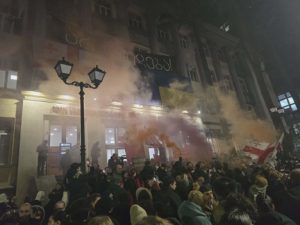
Protest in front of the Ilia State University building, Tbilisi, 12 February 2026. The banner above the entrance reads “[University is] Not for Sale.” Photo: author.
The ruling Georgian Dream party has built its rhetoric against liberal values and campaigned to discredit and dismantle the legacy of the previous government’s reforms and of Georgia’s European turn. This campaign fits neatly with its hostility toward ISU. ISU’s academic community, including the leadership, has stood firmly behind European integration. Its students and academics spoke out against the “foreign agents’ law” and the suspension of EU accession, and they joined the protests that followed. The university’s symbolism reaches far beyond its walls, and so does the logic of the “reform” imposed on it.
The pressure did not begin with the reform. In 2024, despite positive expert assessments, a contested authorisation decision (institutional accreditation) placed ISU under a year of monitoring. Only after protests and an appeal did the university secure an unconditional six-year authorisation in March 2025. Even as we celebrated, we sensed that something worse lay ahead. What we could not have imagined was how dramatic it would be.
Under “One City – One Faculty,” ISU’s annual enrolment quota was cut from roughly 5,000 students to 425, a reduction of 91%. Around 76% of its programmes were eliminated. A rapidly developing, multi-profile university is being pushed back toward the narrow pedagogical profile of a Soviet-era institute. For many, this confirms a long-held suspicion that the reform has become a tool to discipline a university already in the government’s sights.
Even the “core profile” did not count
The reform breaks its own declared principles in many ways, disadvantaging ISU and favouring certain universities. Programmes are duplicated in the ‘same city’, and some fields have been allowed to keep four-year bachelor’s degrees instead of three for reasons no one has explained. Here, however, I want to speak about the School of Education, which I represent.
The reform declared education to be ISU’s core profile. By the logic of “One City – One Faculty,” ISU should have been the sole, or at least dominant, provider of programmes in the field of education in Tbilisi. Instead, it received a quota of just 150 for teacher preparation programmes, while Sokhumi State University, a university in exile also located in Tbilisi, received more than twice that – 330. The master’s programme in Education Administration, where I teach, went from 40 student quota to 5. It was the first programme of its kind in Georgia, built over fifteen years, highly competitive, and with a graduate employment rate of around 90%. This year, 288 people applied for those 5 places. Meanwhile, Tbilisi State University, in the same city, kept its education-field profile, with the teacher training programme and a quota of 30 graduate-level programme, and a similar education administration programme in one of the regional universities, where labour market demand is clearly smaller, was granted 15 places. The reform’s own stated criteria were institutional profile, quality and labour-market demand, and none of them counted. What remains is hard to read as anything other than political retaliation.
Living in suspension
By the time the Ministry announced the quotas in February 2026, the process already felt out of hand. Everything we had anticipated, every risk we had warned about, had come to pass. From then on, the reform would stumble through its own unplanned, unprepared, chaotic implementation, and students and faculty would absorb the consequences in their own lives, even those who had not yet seen it coming, all drawn into a crisis with no end in sight.
What followed was a kind of numbness. We keep teaching as if nothing is happening, while feeling in every cell the brutality of watching years of work building programmes and research erased by obsessive, senseless measures, imposed from above through a political process with no regard for academic interests. The programmes that remain are fragmented by hasty restructuring, and we live with the expectation that at some point there may be no students to teach and no programme to teach in. Lauren Berlant (2011) calls this kind of condition an impasse, in which “crisis ordinariness” becomes the texture of everyday life, something one gets through by improvising, adjusting, and waiting. We carry on, because carrying on is the only form of normality left.
Yet what we are carrying on through is larger than one university. Ilia State University is not the only university at stake. The reform is hollowing out the country’s entire academic system: whole fields of study, the academic quality of what remains and the futures of students and professors alike. Universities are being turned from spaces of independent thought and research into administrative extensions of the state, expected to produce compliant workers rather than critical citizens. What Georgia stands to lose is its capacity for intellectual and cultural production, the capacity to question existing structures of power, to imagine alternatives, and to move toward a democratic and just society. We wonder whether we will survive this, and if we do, what kind of academic community we will have become, and what exactly we will call survival.
And there is always the lingering question of what we could have done differently, and whether any of it would have made a difference. I keep arriving at the same answer that our only real chance was broader solidarity among academic communities across universities, united by a shared understanding of the consequences and a commitment to protecting academic values and integrity. What if, for example, no one had agreed to restructure their programmes within two months? What if every university rector had said that reforms cannot simply be imposed from above? But as time passes and tension rises, exhaustion wears down resilience and survival mode sets in. Where unity is needed, cracks begin to form, and such divisions tend to benefit those in power, whose political goals are to consolidate authoritarian rule, dismantle the country’s democratic institutions, and seize control of every remaining free cultural and intellectual space.
Many colleagues lost hope that protest could change anything, and some never had it. Others stayed silent throughout, perhaps out of fear or fatigue. Some who signed our early petitions gradually withdrew from criticism and aligned themselves with the Ministry, attending its events without raising any critical questions.
Still, in times of deep uncertainty, you experience the pain of losing friends and colleagues, but you also learn who is fighting for what universities stand for and who stays in solidarity with those under pressure. You form new connections, often stronger ones, built on shared values. You learn who holds on to solidarity and integrity, who shows up, and who offers support. In the end, hope lies in the knowledge that this numbness will pass, and that when it does, we will know whom we can count on, both in the fight for genuine change and in the deliberate work of building a free and just academic system, one that serves society rather than power.
Fertile ground for a false promise
None of this happened in a vacuum. It grew out of another, earlier impasse: the condition of Georgian academia had been unbearable for years. Chronic underfunding pushed academics to juggle several jobs just to get by, along with growing managerial and audit demands and workload. The majority of them were left exhausted, unable to do research or keep up with their fields, and either too insecure to speak up or simply indifferent. For some, perhaps, the reform offered a wishful hope that things might finally improve. Others could not imagine how things could get any worse. As for the 10,000 lari, it has quietly been reserved for a new “lead professor” position rather than for professors, as first announced. So far the position exists in law but not in reality. The figure functioned less as policy than as what Berlant (2011) called cruel optimism: an attachment that keeps us hoping even as the conditions for a decent working life are dismantled in its name. What we actually face is mass job losses, arriving slowly as students from cancelled programmes graduate.
Students are caught in the same reality. Many work long hours simply to support themselves, arriving in class exhausted, leaving early for another shift, or not making it at all. Yet their struggle is turned into an argument against the university itself: why study for years if a graduate may earn no more than a taxi driver or a delivery courier? The reform’s other big headline, free education at public universities, speaks directly to this hardship and, in itself, is a genuinely positive step. But free tuition at chronically underfunded universities is not a gift. It simply moves the cost from students’ pockets to the quality of what they receive. The result risks being an education that is free, but emptied out.
This is the public perception the government built its promise on, framing labour-market alignment as the only purpose of higher education and resting on a simple claim: the country does not need this many graduates. What this discourse dismisses is the right question. Instead of asking why educated young people face such conditions, the conversation asks whether the education was worth pursuing. Graduate precarity becomes evidence against the university rather than against the economy that fails them. And once knowledge has to justify itself in earnings, cutting a year off every degree and closing the social sciences can be presented as common sense. That is where anti-intellectualism does its work: not by attacking ideas, but by pricing them.
This is the depleted ground on which the populist promise of national reform in higher education took root.
Every now and then, my friend Lela calls the Ministry chancellery to ask about our four pages of questions, sent in January. It is apparently still “in progress.” So are we. We wait for the next law, the next quota, the next programme list, the next confined research area, wondering which part of university life will be left.
References:
Berlant, L. G. (2011). Cruel optimism. Durham, NC: Duke University Press.
Chakhaia, L., & Tsotniashvili, K. (2026). Between Complicity and Resistance: Higher Education Reform and Academic Community Responses in Georgia amid Authoritarian Resurgence. European Education, 58(3), 227–247. https://doi.org/10.1080/10564934.2026.2711199
Author: Keti Tsotniashvili is an associate professor of education policy at Ilia State University, Georgia, and a postdoctoral researcher at the University of Fribourg, Switzerland (ESKAS Fellow, 2026–2027). Her research explores how historical legacies and emerging geopolitical rationalities reshape universities, academic identities and knowledge production, and how scholars contest and negotiate these changes.
This op-ed is based upon work from COST Action CA22121, Rising nationalisms, shifting geopolitics and the future of European higher education/research openness (OPEN), supported by COST (European Cooperation in Science and Technology).
Share this blog post


