From professional practice to scholarly voice: Rethinking what research can do
I have long felt confident in my professional practice, particularly in developing and delivering project-based initiatives. Much of my career has involved turning ideas into action: identifying opportunities, bringing people and institutions together and creating projects that respond to emerging questions and practical needs.
Perhaps unsurprisingly, I have approached my doctorate in much the same way.
For me, doctoral research has never been solely about producing a thesis. I have always seen it as part of a wider professional journey: an opportunity to understand a problem more deeply, to generate knowledge from practice and ultimately to consider how that knowledge might create value beyond the doctorate itself.
My research interests focus on global knowledge exchange and international partnerships, particularly cross-disciplinary and intercultural experiences that develop through temporary academic mobility across institutions and countries. Having spent many years working in international student recruitment and university partnerships, I have seen how institutional internationalisation activity can become heavily centred on student recruitment, mobility numbers and formal agreements.
Increasingly, however, my attention has turned towards academics themselves.
Higher education is changing rapidly. In my own professional experience, universities are navigating financial pressures, changing patterns of international recruitment, new technologies and shifting expectations around research, teaching, knowledge exchange and global engagement. Academics are operating within this environment while balancing contractual responsibilities, maintaining their professional identities and developing wider networks and collaborations.
I believe there is scope to think more carefully about how academics are supported within this evolving landscape.
My motivation is therefore not simply to complete doctoral research on global knowledge exchange, but to explore how its findings might inform practical models, programmes and opportunities that support academics and practitioners to connect internationally, exchange expertise and develop meaningful partnerships.
This is where I increasingly see myself developing as an early-career academic entrepreneur. I use that term deliberately. I am not early career in professional terms, but I am at an early stage in translating my research into an entrepreneurial academic practice that sits between research, professional experience and enterprise.
My experience at the CGHE Autumn School at the Department of Education, University of Oxford was valuable because it helped me think more clearly about three connected things: research community, publication and voice.
One of the things I appreciated most was the opportunity to meet researchers from different backgrounds, disciplines and stages of their academic journeys.
Doctoral research can become highly focused. I spend considerable periods immersed in my own questions, literature, methods and data. Meeting people working on very different problems interrupted that intensity in a useful way.
It reminded me that there are many ways of being a researcher.
Conversations with other participants reinforced my view that research does not develop in isolation. Ideas became stronger when they were discussed, questioned and viewed through perspectives different from my own. For someone whose research centres on knowledge exchange, there was something particularly appropriate about experiencing this first-hand.
The value for me was not simply in what was formally taught, but also in the exchanges between participants: hearing about another person’s work, recognising unexpected connections and encountering approaches that might never have emerged within my immediate academic environment.
A second important takeaway was a clearer understanding of publication.
Publication had sometimes appeared to me as a mysterious stage of academic work: conduct the research, complete the thesis and then attempt to turn parts of it into journal articles.
The CGHE Autumn School helped me see it differently.
There’s not one route to scholarly publication, nor does all research communication need to take the same form. A piece of research might become a journal article, book or book chapter, conceptual paper or practice-based output. Other aspects of the same research may be better communicated through professional publications, policy contributions or journalism. Different ideas call for different forms.
If I want my research to resonate beyond the thesis, I need to think carefully about both what I want to say and who needs to hear it.
A theoretical contribution may require one kind of outlet. An insight intended to influence professional practice may require another. I now see publication and wider research communication as related but distinct ways of bringing knowledge into different communities.
The Autumn School also encouraged me to think more clearly about scholarly voice.
I bring to my research years of experience across international recruitment, higher education partnerships and intercultural engagement. My doctorate has allowed me to examine those experiences through a more systematic and critical lens.
I no longer see practitioner and researcher as competing identities.
My professional experience helps me identify questions grounded in real challenges. My research allows me to interrogate those questions more critically. Publication and other forms of communication then provide ways of placing those insights into wider conversations.
For me, making my voice heard is not about claiming to have all the answers. It is about being clear about what I can contribute, where that contribution comes from and why it may matter.
I left the CGHE Autumn School thinking not only about what I might publish, but about what I want my research to do.
That distinction is important.
I am particularly interested in how I can commercialise my research more responsibly.
By commercialisation, I do not mean simply turning knowledge into a product. I am interested in how research can inform sustainable services, programmes and partnership models that respond to identifiable needs while remaining grounded in the purpose and evidence of the research itself.
In my case, that could include programmes that support academics to develop international collaborations, frameworks for designing more effective visiting academic programmes or new approaches to academic mobility and knowledge exchange.
For me, the crucial point is that these ideas should be research-informed rather than commercially attached to the doctorate afterwards.
My research is already shaping how I think about the design, experience and sustainability of academic mobility and international knowledge exchange. The next question is how those insights might be translated into forms that universities, academics and practitioners can actually use.
This is the kind of academic entrepreneurship that interests me.
It is not separate from my research. It is one possible route through which the research might create practical and sustainable value.
The Autumn School did not fundamentally change my ambition. It made that ambition more precise.
It helped me see publication not as a final academic task, but as one part of a wider process of knowledge exchange. It helped me think more carefully about the relationship between audience and form. It also reinforced the importance of developing a scholarly voice that is informed by professional experience without being limited by it.
Most importantly, it sharpened the question I now carry forward:
My research does not end when I have produced knowledge. I now need to decide which parts of that knowledge should travel, who they should reach and what form they should take if they are to create meaningful and lasting value.
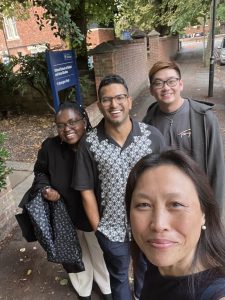
Minyan with colleagues
Share this blog post