Thinking of academic freedom through conversations with fellow Early Career Researchers
In this year’s CGHE Postdoctoral Autumn School, we had the wonderful chance to debate several topics with a great group of Early Career Researchers. We were also delighted by Benjamin Mulvey’s presentation at the CGHE Webinar on ‘Theorising Academic Freedom in a Plural World’.
In this blog, we want to present some reflections on academic freedom, drawing on the conversations ‘on the ground’ we had with colleagues who attended the Autumn School. To some extent, we offer a different, but complementary perspective on academic freedom to Ben’s approach. At the risk of misrepresenting his presentation, in a nutshell, Ben asked how academic freedom – a Western concept – can be applied in other contexts and, with that, within the broader tension between cultural relativism and universalism. In any case, academic freedom requires certain conditions to be enacted, which essentially refer to the actions of the state. Negative freedom refers to the non-intervention of the state and politics in academic work, whereas positive freedom entails the provision of the material conditions needed for free academic work to develop.
Bearing these reflections in mind, what do the perspectives of our colleagues, who came from different continents and live in countries with different political systems, say about academic freedom within the university?
When it comes to imagining how academic freedom is lived, we suggest thinking of it as a spectrum. At the two sides of the spectrum, academic freedom is endangered, but between these two extremes or poles, academic freedom is lived in heterogeneous ways. The left side involves threats related to the lack of negative freedom, namely open political persecution, loss of jobs, imprisonment, violence and/or exile. The right side refers to threats involving the lack of positive freedom, namely the required material conditions. We argue that, in between, there is a space where academic freedom is negotiated – also by ECRs – within each university, in every place in the world.
Regarding restrictions on academic freedom at the left extreme of the spectrum, some colleagues acknowledge significant political restrictions. The threat is real, and they need to take it into account when writing and publishing – or, better said, when deciding what not to write or publish about. While these colleagues experience threats from the left side of the spectrum, they have managed to develop their work by developing various strategies to get around difficult topics. The support provided by colleagues abroad is also important, both for developing these strategies and for providing an academic environment alongside material conditions.
However, restrictions on academic freedom can also occur at rich universities in Western liberal countries, where this notion originated. Where funding has been cut for certain topics, these colleagues may experience restrictions that come closer to the right side of the continuum. However, these material restrictions are usually related to political motivations, so that they involve both extremes of the spectrum.
Notably, the restrictions at both sides of the spectrum refer to the state, that is, to an ‘external’ actor. But when we think about freedom within these two extremes, we suggest to adopt an inward-looking perspective, namely the conditions created and sustained within the university to support or limit academic freedom. This form of restriction is perhaps more subtle.
What happens when certain schools of thought are so strong within a department or university that other epistemological assumptions are precluded from developing? Thus, when it comes to academic freedom, it is important to acknowledge the underlying beliefs about epistemology. A cultural relativist speaks a different language from someone who believes that there is some notion of absolute truth. A postmodernist will identify notions of power, privilege and oppression as they relate to experiences of reality. A constructivist will acknowledge how their interpretative lens enables them to make judgements about the world.
Arguably, within the university, these schools of thought might be part of epistemic hierarchies that reflect social hierarchies within universities, upheld by academics with higher academic ranks. Does this not particularly affect ECRs? What happens when these schools of thought include openly racist, discriminatory and exclusionary assumptions? In that regard, one could ask: what is the responsibility of academics in enabling a rich debate within their departments, beyond the schools of thought that individual researchers legitimately represent and support? Is this not the essence of academic freedom and the reason why state intervention should be avoided, while at the same time such open debate mirrors the values that sustain liberal democracies and justify academic freedom?
This does not neglect the efforts made by scholars across academic ranks to sustain academic freedom, but rather highlights the responsibility that universities have in creating the conditions for freedom to be lived within each department, within the broad spectrum between the poles that challenge freedom. This also recentres the discussion presented by Ben. While there certainly is a challenge in reconciling essentialism and universalism, the experiences of our colleagues suggest that these tensions are lived both ‘outside’ and ‘inside’ the Western world. At a time when liberal democracies are rapidly transforming, sharp divisions between cultural and political realms are becoming less accurate for understanding debates about academic freedom. A focus on ECRs and how they live and negotiate freedom can suggest alternative perspectives and paths to protect it.
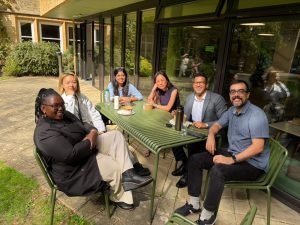
Lautaro (far right) and Joel (second from right) with colleagues
Share this blog post